
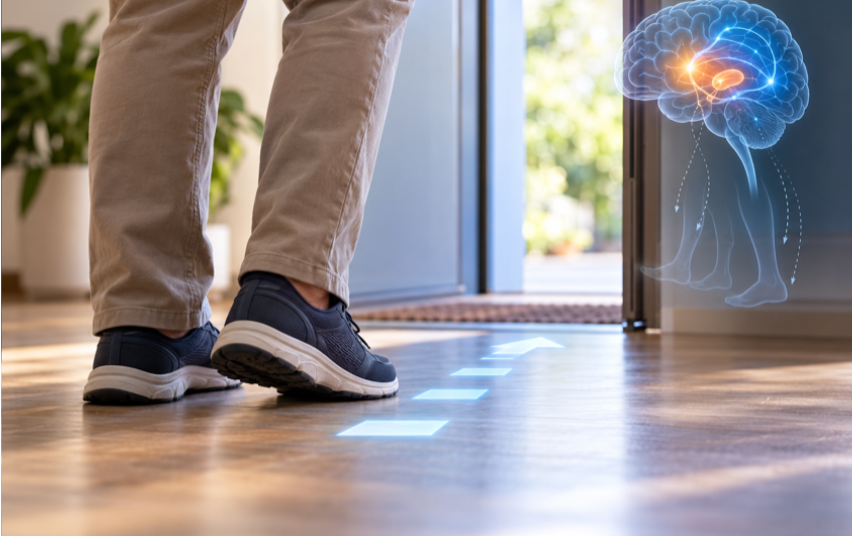
Why Is Walking and Talking So Difficult with Parkinson’s Disease?
Understanding freezing of gait in Parkinson’s disease — and practical strategies that may help you get moving again.
Imagine walking across your living room when suddenly, without warning, your feet seem to stop working. You know exactly where you want to go. You’re trying to take another step, but your feet simply won’t move. Perhaps you’re approaching a doorway, turning around in the kitchen or getting ready to cross a busy road.
For someone living with Parkinson’s disease, this experience can be both frustrating and frightening. It’s known as freezing of gait, often abbreviated to FOG, and it’s one of the more challenging movement symptoms associated with Parkinson’s disease. The encouraging news is that while freezing can be difficult to manage, there are practical strategies that may help people regain movement, improve their confidence and reduce their risk of falling.
What Exactly Is Freezing of Gait?
Freezing of gait is a sudden, temporary difficulty taking an effective step, despite actively trying to move. A person may feel as though their feet have been glued to the floor.
Episodes may last only a few seconds, although some persist considerably longer. Interestingly, freezing doesn’t always mean the legs become completely motionless. Some people experience rapid trembling of their legs while their feet remain in place. Others take a series of very small, ineffective shuffling steps without making meaningful progress.
In January 2026, an international group of researchers published an updated clinical definition of freezing of gait, recognising that it can occur during different types of stepping movements, including starting to walk, turning and walking forwards, backwards or sideways.
The updated definition is particularly useful because it acknowledges that freezing is not simply a complete absence of movement. It can involve several different patterns of ineffective stepping. [1]
Why Does Freezing Happen?
Walking is something most of us take for granted. We rarely think consciously about lifting one foot, transferring our weight and placing the next foot in front of us. Our brains coordinate these movements automatically, allowing us to walk while talking, looking around or thinking about something else.
Parkinson’s disease affects the brain networks responsible for planning, initiating and coordinating movement. As the disease progresses, movements that were previously automatic may require greater conscious attention. Freezing appears to involve disruptions in several interacting brain networks responsible for movement, attention and cognitive control. The precise mechanisms are not yet fully understood. What we do know is that freezing frequently occurs when the brain is required to manage several movement or thinking demands simultaneously.
This helps explain why someone may walk reasonably well along a straight, open pathway but suddenly freeze when approaching a doorway or attempting to turn.
The important thing to understand is that freezing is not a lack of effort or motivation.
The person is genuinely trying to move, but the neurological processes required to produce an effective step are temporarily disrupted.
When Is Freezing Most Likely to Occur?
Although freezing can happen unexpectedly, there are several situations in which episodes are more common.
1. Starting to walk:
Some people experience freezing when attempting to take their first step after standing up or remaining stationary. This is known as start hesitation. Interestingly, the person may be standing quite upright and appear reasonably stable, yet still be unable to take that first step. Walking requires the brain to organise subtle changes in posture and weight distribution before the stepping foot can leave the ground. These are known as anticipatory postural adjustments.
In Parkinson’s disease, these automatic preparations for movement can become disrupted. This helps explain why someone may be able to stand comfortably but still experience considerable difficulty getting started.
2. Turning around
Turning requires the brain to coordinate changes in direction, balance and foot placement. For some people, particularly when turning in confined spaces, these demands can trigger freezing.
3. Walking through doorways
Doorways are one of the most commonly reported triggers. The transition from one space to another, particularly through a narrow opening, can interfere with the automatic coordination of walking.
4. Approaching a destination
Freezing sometimes occurs when approaching a chair, bed, kitchen bench or another intended destination. The person may walk relatively well until they are almost where they want to be.
5. Doing two things at once
Walking while talking, carrying something or concentrating on another activity may increase the likelihood of freezing. This is known as dual-tasking.
6. Feeling rushed, stressed or anxious
Emotional stress and time pressure can increase the demands placed on movement and attention. Some people notice that freezing becomes more frequent when they’re anxious about falling or feel pressured to move quickly.
7. Changes in medication effectiveness
Freezing may become more noticeable when Parkinson’s medication is wearing off, although it can also occur when medication is working well. Recognising these patterns can help guide discussions with the treating neurologist and rehabilitation team. [1, 2, 3]
Can Reduced Foot Sensation or Poor Vision Make Walking More Difficult?
Walking relies on more than muscle strength and movement coordination. Our brains constantly receive information from our feet, joints and eyes to help us understand where our bodies are positioned and how we are moving.
The sensation beneath our feet helps us recognise contact with the ground and changes in pressure as we transfer our weight. Another important sensory function is proprioception — our ability to recognise the position and movement of our limbs without having to look at them.
Vision also contributes important information about the environment, helping us judge distances, recognise obstacles and plan where to place our feet. Research suggests that difficulties with proprioception, visual processing and the integration of sensory information may contribute to the challenges experienced by people with Parkinson’s disease.
In a 2020 study involving 130 people with Parkinson’s disease, researchers identified poorer proprioception and impaired balance control as significant factors associated with freezing of gait [6].
Further research has explored differences in how people with and without freezing use visual information during walking, including their responses to visual cues [7].
These findings suggest that assessing sensory and visual function may provide valuable additional information when investigating walking difficulties. This raises an interesting question: if someone with Parkinson’s also has reduced sensation in their feet, perhaps from peripheral neuropathy, could this make walking even more challenging? From a neurological perspective, this is plausible. However, we do not yet have sufficient evidence to conclude that peripheral sensory loss directly causes freezing episodes.
What we can say is that reduced sensory information may place additional demands on an already challenged movement-control system. This is one reason why a comprehensive gait and balance assessment may include testing foot sensation, proprioception, balance and visual function, alongside an assessment of walking.
Identifying these additional difficulties can help clinicians develop more individualised management strategies.
Why Is Freezing of Gait a Concern?
Freezing can significantly affect a person’s confidence and independence. One of the greatest concerns is the increased risk of falling. During a freezing episode, the feet may stop progressing while the person’s body continues to move forwards.
This mismatch can result in a loss of balance. Some people respond by trying harder to force themselves forwards, which may increase instability. Others begin avoiding activities because they’re worried about freezing in public or falling when nobody is nearby. Over time, this can lead to reduced physical activity, loss of confidence and increasing dependence on others. This is why I believe it’s important to address freezing early, rather than waiting until falls become frequent.
What Can You Do When Your Feet Freeze?
There is no single strategy that works for everyone. However, several techniques can help some people interrupt a freezing episode and restart walking. One useful approach is to remember four simple actions.
STOP – STAND – SHIFT – STEP
- STOP
If you feel your feet beginning to freeze, avoid trying to force yourself forwards. Pause and allow yourself a moment to regain control.
- STAND
If you can do so safely, straighten your posture and focus on standing tall. Take a comfortable breath and try to reduce the sense of urgency.
- SHIFT
Gently transfer your weight from one leg to the other. This can help prepare the body to lift one foot and initiate the next step.
- STEP
Once your weight is securely transferred, consciously lift the other foot and take a deliberate step. Think about making the step clear and purposeful rather than rushing.
These techniques should initially be practised with an appropriately trained clinician, particularly if you have experienced falls or significant balance difficulties. If you’re unable to regain movement safely, seek assistance rather than repeatedly trying to push through the episode. [2, 4]
Using Cues to Help Restart Walking
One of the most interesting aspects of freezing of gait is that certain external cues can sometimes help a person initiate movement when their usual walking pattern has become disrupted. A cue provides an additional signal that helps direct attention towards a particular movement.
There are several types of cues.
- Visual cues: Some people respond well to having a clear visual target. Examples include:
-
- Imagining a line on the floor and stepping over it.
- Stepping towards a clearly identified floor marking.
- Using a specialised walking aid that projects a laser line onto the ground.
Visual cues may be particularly helpful for some people who experience freezing when starting to walk.
- Auditory cues
Rhythm can also help initiate and regulate movement. Examples include:
-
- Counting aloud: “One, two, three, step.”
- Walking to a metronome.
- Stepping in time with music.
- Humming a familiar rhythmic tune.
- Movement and attentional cues
Some people find it helpful to consciously change the movement they are attempting. This might involve:
-
- Gently rocking from side to side.
- Taking a deliberate sideways step.
- Imagining a marching movement.
- Focusing on lifting one knee rather than simply trying to move forwards.
Research supports the use of external cueing as part of physiotherapy management for Parkinson’s disease, including freezing of gait. However, the effectiveness of different cues varies between individuals and circumstances. A strategy that works well at home may not work as effectively in a crowded or unfamiliar environment.
This is why individual assessment and practice are so valuable. [3, 4, 5]
Why Turning Can Be Particularly Difficult
Turning is a complex movement. It requires us to change direction while continuously adjusting our balance and foot placement. For people living with Parkinson’s, turning may become slower, less coordinated and more difficult to initiate.
Some people attempt to turn by rotating their upper body while keeping their feet relatively stationary. This can increase the risk of losing balance or triggering a freezing episode. An alternative is to use a series of deliberate steps to turn in a wider arc.
Rather than pivoting sharply on one foot, the person consciously lifts and places each foot as they change direction. This technique is sometimes described as a wide-arc turn or clock turning. For someone who freezes frequently when turning, practising a safer turning strategy with a neurological physiotherapist may be particularly helpful.
Can Your Footwear Make Freezing of Gait Worse?
Something I regularly observe when assessing people with Parkinson’s disease is how much their footwear can influence their walking pattern. People with Parkinson’s often develop shorter steps, reduced foot clearance and a tendency to shuffle rather than lift their feet normally. When footwear is poorly fitted or has an unsuitable sole, these difficulties can become more noticeable.
For example, shoes with excessively grippy soles may make it harder for some people to move their feet smoothly across the floor, particularly when turning. Conversely, shoes that are too slippery can increase the risk of falling. Heavy or poorly fitting shoes may also make it more difficult to lift the feet, while loose slippers and backless footwear can compromise stability.
What Should You Look for in a Shoe?
For someone experiencing freezing or shuffling, I generally recommend considering footwear with:
- A secure fastening: Laces or adjustable straps that hold the foot comfortably in position.
- A firm heel counter: To provide support and help control unwanted movement within the shoe.
- An appropriate sole: Enough grip for safety, without excessive traction that makes turning or stepping difficult.
- A stable, lightweight construction: Avoiding unnecessarily heavy or excessively soft, unstable footwear.
- Adequate toe room and a suitable fit: Allowing comfortable movement without the shoe being too long or loose.
The ideal footwear will vary according to the person’s walking pattern, balance, foot structure and the surfaces they regularly walk on.
It’s important to recognise that footwear does not cause the neurological freezing associated with Parkinson’s disease. However, unsuitable footwear may contribute to catching, dragging or difficulty moving the feet, making an existing walking problem more challenging.
I often find it helpful to assess a person’s walking in their usual footwear, rather than simply examining their feet while seated. Sometimes relatively small changes in footwear can make walking feel easier and more secure. For anyone experiencing frequent freezing, shuffling or falls, an individualised podiatry and gait assessment can be a valuable part of their overall Parkinson’s management.
Does Exercise Help Freezing of Gait?
Exercise is an important component of Parkinson’s disease management. While exercise cannot guarantee that freezing episodes will disappear, appropriately designed rehabilitation may improve aspects of walking, balance, strength and movement control.
There is evidence supporting gait training, external cueing and targeted physiotherapy interventions for people with Parkinson’s disease. However, freezing is complex, and improvements achieved during supervised training do not always transfer automatically into everyday environments. A comprehensive exercise program may include:
- Gait training: Practising step length, walking initiation, turning and changes in direction.
- Balance exercises: Improving stability and the ability to adjust body position during movement.
- Strength training: Supporting the muscles required for standing, walking and maintaining mobility.
- Cueing practice: Learning which visual, auditory or movement strategies are most effective for the individual.
- Functional movement training: Practising everyday activities such as standing from a chair, approaching a doorway or moving through confined spaces.
- Dual-task training: Carefully progressing the ability to manage movement alongside another activity, when appropriate and safe.
The aim is not simply to improve performance during an exercise session. It is to help people apply useful movement strategies in the situations that matter most to them. [4, 5]
What About Parkinson’s Medication?
For some people, freezing becomes more frequent when their medication is wearing off. These episodes are often described as OFF-period freezing.
In these circumstances, reviewing medication timing and effectiveness with the treating neurologist may be beneficial. However, not all freezing responds to medication. Some people experience freezing even when their other Parkinson’s symptoms are well controlled. This is sometimes called ON-period freezing.
Because medication responses vary, changes should always be discussed with the treating medical team. Exercise and movement strategies can complement medical treatment, but they are not a replacement for appropriate neurological care. [2, 3]
How Can Family Members and Carers Help?
Watching someone experience a freezing episode can be unsettling, particularly when there is a risk of falling. The natural reaction may be to reach out, pull the person forwards or encourage them to hurry. Unfortunately, this can sometimes make the situation more difficult or increase the risk of a fall.
A more helpful approach is to:
- Remain calm and give the person time.
- Avoid pushing or pulling them forwards.
- Encourage them to stop and regain their balance.
- Offer a familiar cue, such as counting or suggesting a weight shift.
- Allow them to initiate movement when they feel ready.
- Seek assistance if they cannot move safely.
Carers can also play an important role in identifying patterns. For example, does freezing occur more often before medication is due, when turning in the bathroom or when approaching the front door? Sharing these observations with the treating clinician can help guide management. [2, 3]
Making the Home Environment Safer
For someone experiencing freezing, the home environment can influence both confidence and safety. Practical considerations may include:
- Keeping walking pathways clear of clutter.
- Reviewing loose rugs and other trip hazards.
- Ensuring adequate lighting, particularly at night.
- Allowing sufficient space for turning.
- Considering the positioning of furniture in narrow areas.
- Reviewing footwear and walking aids.
- Seeking an occupational therapy home assessment where appropriate.
Walking aids should be individually assessed. Some devices may improve stability, while others can create additional challenges when turning or negotiating confined spaces.
When Should You Seek Professional Advice?
If freezing is beginning to affect your walking, confidence or daily activities, it’s worth discussing with your neurologist and an exercise physiologist or physiotherapist experienced in Parkinson’s disease. Assessment is particularly important if:
- Freezing episodes are becoming more frequent.
- You’ve experienced a fall or near fall.
- You’re having difficulty turning or walking through doorways.
- Freezing appears related to medication timing.
- You’re avoiding activities because you’re worried about falling.
- Your walking pattern has changed significantly.
A sudden or dramatic change in walking ability, especially with new weakness, confusion or other acute symptoms, requires prompt medical assessment rather than assuming it is simply Parkinson’s progression.
My Final Thoughts
One of the most important things I’ve learnt from working with people living with Parkinson’s disease is that movement difficulties are rarely the same from one person to another.
Two people may both experience freezing of gait, yet the circumstances that trigger their episodes and the strategies that help them regain movement may be quite different. For one person, counting aloud may be effective. For another, shifting their weight or stepping towards a visual target may work better.
And for someone else, the greatest improvement may come from addressing medication fluctuations, changing how they turn or modifying their environment.
Freezing of gait can be frightening, but understanding why it happens and learning individualised movement strategies can help people feel more confident and better prepared.
At Sunshine Coast Health Services’ Parkinson’s Exercise Centre, our multidisciplinary team supports people living with Parkinson’s through individualised neurological rehabilitation and appropriately adapted exercise programs. Our focus is on helping people maintain their mobility, confidence, physical function and independence for as long as possible.
If you or someone you care for is experiencing freezing of gait, speak with your treating health professionals about an individualised assessment and management plan.
References and Further Reading
- International Consortium for Freezing of Gait. (2026). An updated definition of freezing of gait. Nature Reviews Neurology, 22, 172–181.
https://doi.org/10.1038/s41582-025-01179-3 - Parkinson’s Australia. Freezing of Gait (FoG).
https://www.parkinsons.org.au/information-hub/gait-disturbances/freezing/ - Parkinson’s Foundation. Freezing.
https://www.parkinson.org/living-with-parkinsons/management/activities-daily-living/freezing - American Physical Therapy Association. Physical Therapist Management of Parkinson Disease: A Clinical Practice Guideline.
https://pmc.ncbi.nlm.nih.gov/articles/PMC9046970/ - American Parkinson Disease Association. 10 Tips to Overcome a Parkinson’s Freezing Episode.
https://www.apdaparkinson.org/what-is-parkinsons/symptoms/freezing/ - Lord SR, et al. (2020). Freezing of Gait in People with Parkinson’s Disease: Nature, Occurrence, and Risk Factors.Journal of Parkinson’s Disease, 10(2), 631–640.
https://doi.org/10.3233/JPD-191813 - Graham L, et al. (2023). Visual Exploration While Walking With and Without Visual Cues in Parkinson’s Disease: Freezer Versus Non-Freezer. Neurorehabilitation and Neural Repair, 37(10), 734–743.
https://doi.org/10.1177/15459683231201149
This article provides general educational information and is not a substitute for individual medical assessment, treatment or rehabilitation advice.
