
Why Is Walking and Talking So Difficult with Parkinson’s Disease?
Understanding dual-tasking, balance and why the brain sometimes struggles to do two things at once.
By the Parkinson’s Exercise Centre Team | Sunshine Coast Health Services
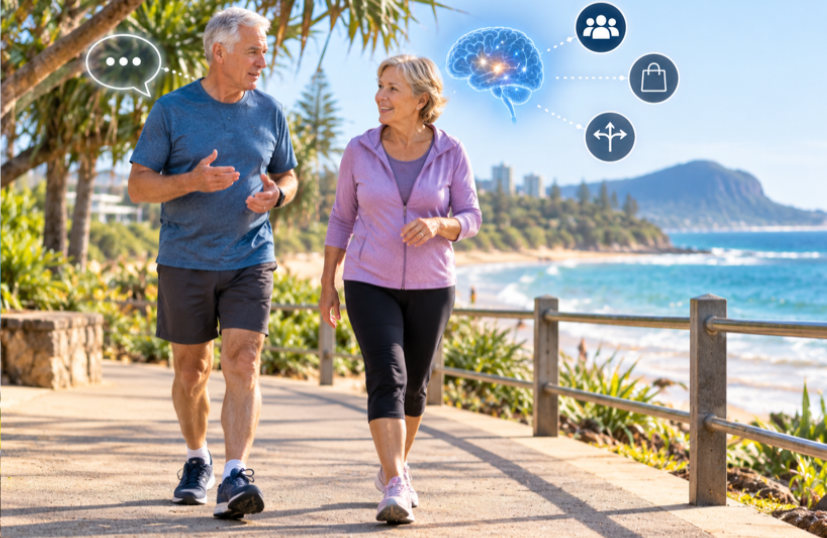
Have you ever noticed someone with Parkinson’s disease walking quite comfortably until you start a conversation with them? Suddenly, their steps become shorter. They slow down, hesitate or even stop walking altogether. Perhaps you’ve noticed something similar when carrying a shopping bag, looking for your keys or trying to negotiate a busy shopping centre. These situations have something important in common: they require the brain to manage more than one task at the same time. This is known as dual-tasking, and it can become particularly challenging for people living with Parkinson’s disease.
Understanding why this happens is an important part of improving walking confidence, balance and everyday safety.
Walking Isn’t as Automatic as We Think
For most healthy adults, walking is largely automatic. We can usually walk while talking to a friend, looking at shop windows or planning what we’re going to cook for dinner. Our brains coordinate the movements involved in walking without requiring us to think consciously about every step. Parkinson’s disease changes this.
The neurological changes associated with Parkinson’s can interfere with the brain’s ability to produce smooth, automatic movements. As a result, walking may require more conscious attention. Instead of simply walking, a person may need to concentrate on their step length, posture, balance and direction. When another task is introduced, such as answering a question, the brain must divide its attention between competing demands. For some people, this causes their walking to deteriorate.
What Is Dual-Tasking?
Dual-tasking means performing two activities at the same time. These may involve two physical tasks, or a combination of movement and thinking.
Everyday examples include:
- Walking while having a conversation.
- Carrying a cup of tea while moving through the house.
- Walking while counting backwards.
- Turning around while answering a question.
- Carrying shopping bags while negotiating a doorway.
- Walking through a busy environment while looking for a particular shop.
Most of us perform these activities without giving them much thought. However, for someone with Parkinson’s disease, combining tasks may result in slower walking, shorter steps, reduced balance control or increased hesitation. Clinicians sometimes describe this change in performance as the dual-task cost.
In simple terms, it means that one or both activities become more difficult when performed together.
Why Does Parkinson’s Affect Dual-Tasking?
Walking involves several interacting brain systems. These systems help us initiate movement, maintain balance, respond to our surroundings and adjust our walking pattern. Parkinson’s affects the networks involved in automatic movement control, but attention and executive functions may also be affected.
Executive functions help us plan, organise, switch between activities and manage competing demands. When walking becomes less automatic, a person may rely more heavily on these cognitive resources. This creates a problem when another activity requires attention. For example, someone may walk well when concentrating entirely on their steps but become less stable when asked to answer a complicated question. The difficulty is not simply that they cannot concentrate.
Their brain is being asked to coordinate activities that now require more conscious control than they once did.
Why Is This Important for Balance?
Balance is not just about standing still without falling. It requires the nervous system to continually adjust the body’s position as we move. Every time we take a step, turn, reach or change direction, our balance systems must respond.
For people with Parkinson’s, these adjustments can become slower or less effective. When attention is divided, there may be fewer cognitive resources available to manage walking and balance.
This can result in:
- Reduced walking speed.
- Shorter or less consistent steps.
- Difficulty changing direction.
- Increased postural instability.
- Greater hesitation when approaching obstacles.
- An increased risk of losing balance in challenging situations.
Dual-task difficulties may also interact with freezing of gait, particularly when walking through doorways, turning or navigating crowded environments. However, not everyone with Parkinson’s experiences the same degree of difficulty.
Can Dual-Tasking Be Assessed?
Yes. During a neurological gait and balance assessment, we can observe how someone walks under different conditions. For example, we might first assess their walking along a clear pathway without distractions.
We can then compare this with walking while performing a simple cognitive task, such as naming items in a category or counting backwards. We observe whether their walking speed, step length, balance or rhythm changes.
We also consider what happens to the secondary task. Some people stop talking to concentrate on walking, while others continue talking but become less stable. Assessments may include the Timed Up and Go test, dual-task walking tests and more comprehensive balance measures such as the Mini-BESTest. Importantly, these assessments must be adapted to the person’s abilities and performed with appropriate supervision.
The aim is not to make someone struggle. It is to understand how their movement changes when everyday demands become more complex.
Can Exercise Improve Dual-Tasking?
Research suggests that targeted training can improve aspects of walking and balance in people with Parkinson’s disease. A 2023 systematic review and meta-analysis examined 17 randomised controlled trials involving 826 participants. The researchers reported improvements in several measures of gait and balance following dual-task training. A further systematic review published in 2024 found that dual-task training improved some aspects of walking under dual-task conditions compared with single-task training, although the certainty of evidence varied.
These findings are encouraging. However, dual-task training is not necessarily appropriate for everyone, and improvements during exercise sessions do not guarantee fewer falls in everyday life. The challenge is to provide exercises that are appropriate to the individual’s movement abilities, balance confidence and stage of Parkinson’s disease.
What Might Dual-Task Training Involve?
At our Parkinson’s Exercise Centre, we recognise the importance of combining physical exercise with activities that challenge movement planning, coordination and attention. Depending on the individual, supervised activities might include:
- Walking with simple cognitive challenges: For example, walking while naming familiar objects or responding to straightforward questions.
- Stepping and changing direction: Practising deliberate steps, turning and negotiating a planned pathway.
- Balance and reaching activities: Maintaining a stable position while reaching towards a target or performing a second controlled movement.
- Rhythm and coordination exercises: Using appropriate movement sequences to encourage coordination and attention.
- Functional activities: Practising movements that relate directly to daily life, such as carrying a lightweight object while walking or preparing to turn towards a chair.
These activities should be introduced progressively. For someone with significant freezing, postural instability or a history of falls, the initial priority may be to improve the safety and consistency of individual movements before adding another task.
Is It Always Better to Practise Doing Two Things at Once?
Not necessarily. This is an important distinction. Although dual-task training may be beneficial in a supervised rehabilitation setting, attempting difficult dual-task activities independently can increase risk.
For example, someone who already struggles with balance may not be safe walking while looking at their mobile phone or carrying several objects. Sometimes the safest strategy is to stop walking before concentrating on another activity.
If you need to answer a complicated question, look for something in your handbag or read a message, pause somewhere safe before doing so. Learning when to divide attention — and when not to — is an important part of managing Parkinson’s safely.
The Importance of Sensory Feedback
Walking and balance also depend on information from our feet, joints, eyes and vestibular system. These systems help the brain recognise body position and respond to changes in the environment. Where someone also experiences reduced foot sensation, impaired proprioception or visual difficulties, managing complex walking tasks may become even more challenging. For this reason, a comprehensive assessment may need to look beyond Parkinson’s-related movement symptoms alone.
Footwear, foot sensation, vision, muscle strength, joint mobility and balance responses can all influence how confidently someone moves. This is particularly relevant for people who experience both Parkinson’s disease and peripheral neuropathy. While sensory impairment does not necessarily explain dual-task difficulties, identifying additional problems can help guide a more individualised rehabilitation program.
Practical Strategies for Everyday Life
If you or someone you care for experiences difficulty walking while performing another activity, several practical approaches may help.
Give walking your attention when necessary.
If the environment is unfamiliar, crowded or difficult to negotiate, concentrate on moving safely before attempting another task.
Avoid rushing.
Allow extra time when approaching doorways, turning or moving through busy areas.
Reduce unnecessary distractions.
Try to avoid complicated conversations while negotiating stairs, uneven surfaces or other challenging environments.
Use deliberate movement strategies.
Where appropriate, focus on posture, step length and controlled changes in direction.
Review your footwear.
Well-fitting, stable footwear can support safer movement. Loose slippers, poorly secured shoes or inappropriate soles may make walking more difficult.
Seek an individual assessment.
If walking deteriorates noticeably when attention is divided, a neurological gait and balance assessment may help identify appropriate rehabilitation strategies.
What Can Family Members and Carers Do?
Family members may notice dual-task difficulties before the person with Parkinson’s recognises them. For example, a person may appear to walk well during a quiet morning stroll but become hesitant when someone starts asking questions. It can help to recognise that this is not necessarily a failure to listen or pay attention.
Walking may simply require more concentration. When supporting someone with Parkinson’s:
- Allow them time to complete difficult movements.
- Avoid asking complicated questions while they negotiate challenging spaces.
- Encourage them to stop somewhere safe before responding if necessary.
- Avoid rushing them when walking or turning.
- Discuss any increasing balance difficulties or falls with their treating team.
Small changes in communication and the environment can make everyday activities less demanding.
My Final Thoughts
One of the most interesting aspects of working with people living with Parkinson’s disease is observing how much walking can change depending on what else the person is doing. Someone may walk quite confidently in a quiet treatment room but experience considerably more difficulty when turning, talking or navigating a busy environment.
This reminds us that walking is not simply a matter of muscle strength. It involves movement planning, sensory feedback, balance, attention and the ability to respond to our surroundings.
The goal of rehabilitation is not just to help someone walk better during an exercise session. It is to help them move more confidently and safely in everyday life.
At Sunshine Coast Health Services’ Parkinson’s Exercise Centre, our multidisciplinary team provides individualised rehabilitation and group exercise programs designed to support movement, strength, balance and functional independence.
By understanding the specific challenges each person experiences, we can develop practical strategies that are relevant to their daily activities and personal goals. If walking, balance or divided attention is becoming difficult, speak with your neurologist and a physiotherapist or exercise physiologist experienced in Parkinson’s disease about an individualised assessment.
References and Further Reading
- Efficacy of Dual-Task Training in Patients with Parkinson’s Disease: A Systematic Review with Meta-Analysis.Movement Disorders Clinical Practice. 2023;10(9):1268–1284.
https://doi.org/10.1002/mdc3.13823 - Lin X, et al. Comparing the effects of dual-task training and single-task training on walking, balance and cognitive functions in individuals with Parkinson’s disease: A systematic review. Chinese Medical Journal. 2024;137(13):1535–1543.
https://doi.org/10.1097/CM9.0000000000002999 - Dual-Task vs. Single-Task Gait Training to Improve Spatiotemporal Gait Parameters in People with Parkinson’s Disease: A Systematic Review and Meta-Analysis. 2024.
https://pubmed.ncbi.nlm.nih.gov/38790495/ - Physical Therapist Management of Parkinson Disease: A Clinical Practice Guideline.
https://pmc.ncbi.nlm.nih.gov/articles/PMC9046970/
This article provides general educational information and does not replace individual medical or rehabilitation advice. People with significant balance difficulties or a history of falls should undertake challenging exercises only with appropriate professional supervision.
